

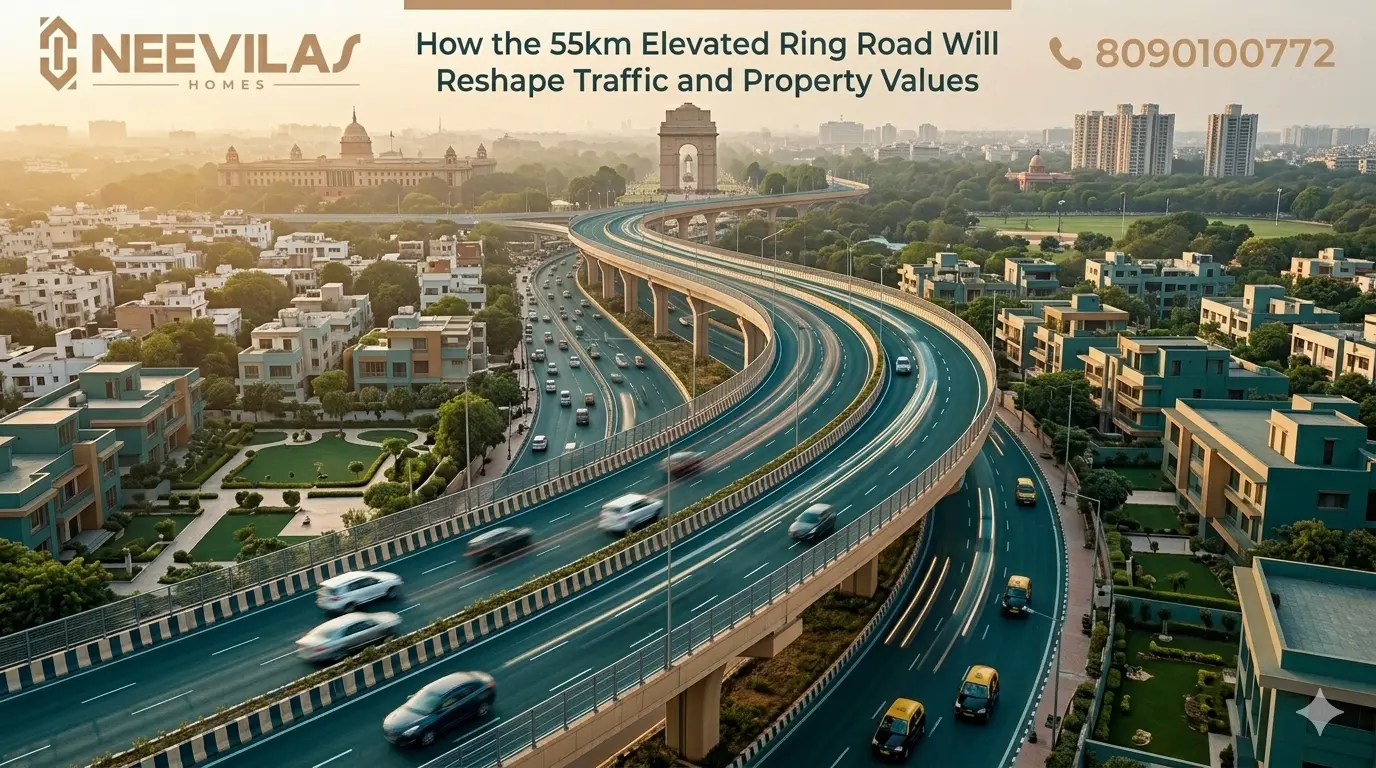
Delhi is on the cusp of an infrastructure transformation that promises to fundamentally alter the city’s movement. The approval of the 55-kilometre elevated Ring Road, a “double-decker” transit system, is not just an engineering feat; it is a strategic intervention designed to break the gridlock that has defined the capital’s commute for decades.
For residents, commuters, and investors, this project represents more than just miles of bitumen and concrete. It is a catalyst for economic shifts and a new era of urban accessibility.
The Strategic Impact on Traffic
The Mahatma Gandhi Ring Road has served as the main road for the city since its construction, but intersection congestion and through-traffic from other areas have reduced its effectiveness. The new elevated corridor aims to solve this through a tiered approach:
- Segregation of Traffic: By shifting long-distance travellers to the upper deck, the surface-level road can finally breathe. The system creates dedicated paths which allow North to South Delhi commuters to bypass all local traffic jams at Ashram and AIIMS.
- The End of the Signal-Stop: The project is designed to be entirely signal-free. By bypassing existing flyovers and metro lines at heights of up to 20 meters, the “stop-and-go” nature of Delhi driving will be replaced by a continuous flow, potentially cutting cross-city travel times by 40%.
- Pressure Relief for Arterial Roads: As the Ring Road becomes more efficient, we will likely see a “drainage effect” on parallel arterial roads. Outer Ring Road and Mathura Road, which often absorb the overflow from a congested Ring Road, will see a significant reduction in spillover traffic.
This project does not exist in a vacuum
Its true power lies in how it interacts with other mega-projects currently under construction. The integration with the Delhi-Dehradun Expressway and the expansion of the Delhi Metro create a high-velocity “transit hub” effect. When an elevated expressway sits within minutes of a major highway and a metro station, the result is a massive increase in “locational utility”—the ease with which a resident can reach any part of the NCR.
Why Location Matters Now
Infrastructure is the single most reliable predictor of real estate appreciation. When connectivity improves, land value follows a predictable upward trajectory. We are seeing this play out in real-time across the Delhi-NCR landscape.
While South and Central Delhi see incremental growth, the most dramatic shifts are occurring in the North East and Northern peripheries, where new connectivity is unlocking previously “frozen” value.
Sabhapur Extension- A case study
A prime example of this “infrastructure-led gold rush” is Sabhapur Extension in North East Delhi. Its proximity to Majnu Ka Tila, a key node on the new elevated Ring Road plan, has placed it in the direct path of growth.
- Exponential Growth: Areas like Sabhapur Extension have already demonstrated a staggering 300% growth in property prices over the last five years.
- The Catalyst Effect: This appreciation isn’t accidental. Three main elements combine to create this situation.
- High-Speed Proximity: Being just 1 km away from the Delhi-Dehradun Expressway provides unparalleled interstate connectivity.
- Public Transit Access: With a Metro station within 2.5 km, the area caters to both private vehicle owners and public transport users. The new elevated project will establish additional connections between northern areas and South and West Delhi commercial centres through the Ring Road Link.
As construction on the elevated Ring Road begins over the next six months, the window for “pre-infrastructure” pricing is closing. The lesson for investors becomes evident through their need to examine the locations where new elevated corridors intersect with current highway and metro system networks.
The 55km project will do more than just shave minutes off a commute; it will create new prime residential neighbourhoods and commercial districts through the transformation of previously neglected areas into high-value development zones. The Sabhapur Extension area demonstrates how greater accessibility can meet existing demand needs.