

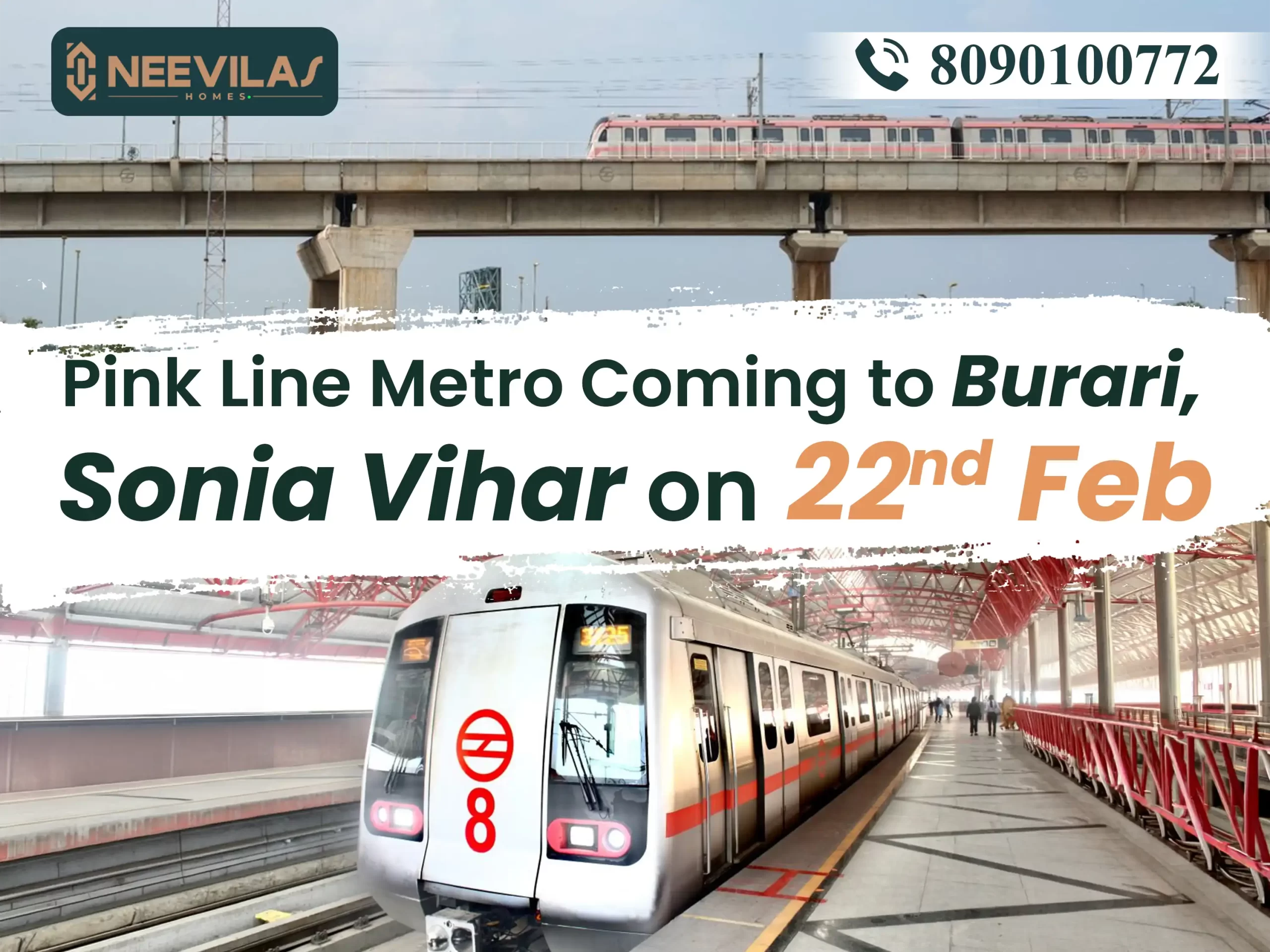
The wait is finally over! Pink Line Metro Coming to Burari, Sonia Vihar and many other underdeveloped regions of trans yamuna. The Delhi Metro Pink Line extension is set to transform Burari and Sonia Vihar transit, and will be inaugurated by PM Modi himself on 22nd February, 2026 as mentioned in the notice released by the DMRC, redefining urban mobility with the upcoming inauguration of the Majlis Park to Maujpur section.
This 12.3 km elevated corridor is the final piece of the puzzle that completes India’s first-ever Ring Metro, creating a seamless circular loop around the capital. For residents of Burari and Sonia Vihar, this means a direct ticket to a faster, air-conditioned, and traffic-free lifestyle.
As part of the ambitious DMRC Phase 4 expansion, the new stretch features key stations including Burari metro station, Jharoda Majra, Jagatpur Village, Sonia Vihar, Khajuri Khas, and Bhajanpura. This development is more than just a transport update; it’s a massive economic booster. With the Pink Line metro opening soon, real estate in North East Delhi is already witnessing a surge, as these previously “far-flung” neighborhoods transform into high-value transit hubs connected directly to South and West Delhi.
What the “Ring Metro” Means for daily commuters
For years, commuting from North Delhi to East Delhi felt like a cross-country trek, often requiring multiple bus changes or long crawls through the traffic at Signature Bridge. With the completion of this 12.3 km corridor, the Pink Line becomes a complete circle.
How the Pink line extension is changing the Transit in Burari and Sonia Vihar
- No More U-Turns: You can now travel clockwise or anti-clockwise around the city.
- Fewer Interchanges: If you live in Sonia Vihar or Bhajanpura, you no longer need to travel to Kashmere Gate just to switch lines. You are now directly plugged into a network that touches every major part of Delhi.
- Time is Money: Travel time from Burari to South Delhi hubs like Lajpat Nagar or INA is expected to drop by nearly 40%, giving commuters hours of their lives back every week.
The Double-Decker Spotlight
One of the most informative aspects of this new stretch is the architectural genius between Bhajanpura and Yamuna Vihar. To tackle the heavy congestion on Wazirabad Road, the DMRC has constructed a unique double-decker viaduct.
In this 1.4 km section, the Metro tracks run on the top deck, while a road flyover runs right below it on the same pillars. This “2-in-1” structure is a first for this part of the city, ensuring that while the metro zooms above, the road traffic below also gets a much-needed breathing space.
Local Transformation: Burari, Khajuri Khas, and Sonia Vihar
The arrival of the Delhi Metro Rail Corporation (DMRC) services is doing more than just moving people; it’s moving the economy.
- Burari & Jagatpur: These areas are shedding their “outer Delhi” tag. With the Burari metro station becoming operational, students heading to Delhi University’s North Campus and professionals working in Gurgaon or Noida will find their daily commute significantly easier.
- Khajuri Khas & Bhajanpura: These are now officially “Metro Hubs.” The proximity to the metro is sparking a real estate boom, with commercial interest peaking in these dense market areas.
- Sonia Vihar: Often ignored in past infrastructure drives, Sonia Vihar and Sabhapur Extension, now stands as a major gateway. The new metro bridge over the Yamuna, DMRC’s fifth, connects this pocket directly to the mainstream city grid.
According to the latest notices, the tentative inauguration by PM Narendra Modi is scheduled for February 22nd, 2026. The stations are being decked up, the digital plaques are being set, and trial runs have already ensured that the tracks are ready for the thousands of daily commuters.
Whether you are a student, an office-goer, or an investor, the Pink Line extension is the heartbeat of a new, connected North East Delhi. The days of being “stuck in traffic” are being replaced by the “next station is…” announcement.