

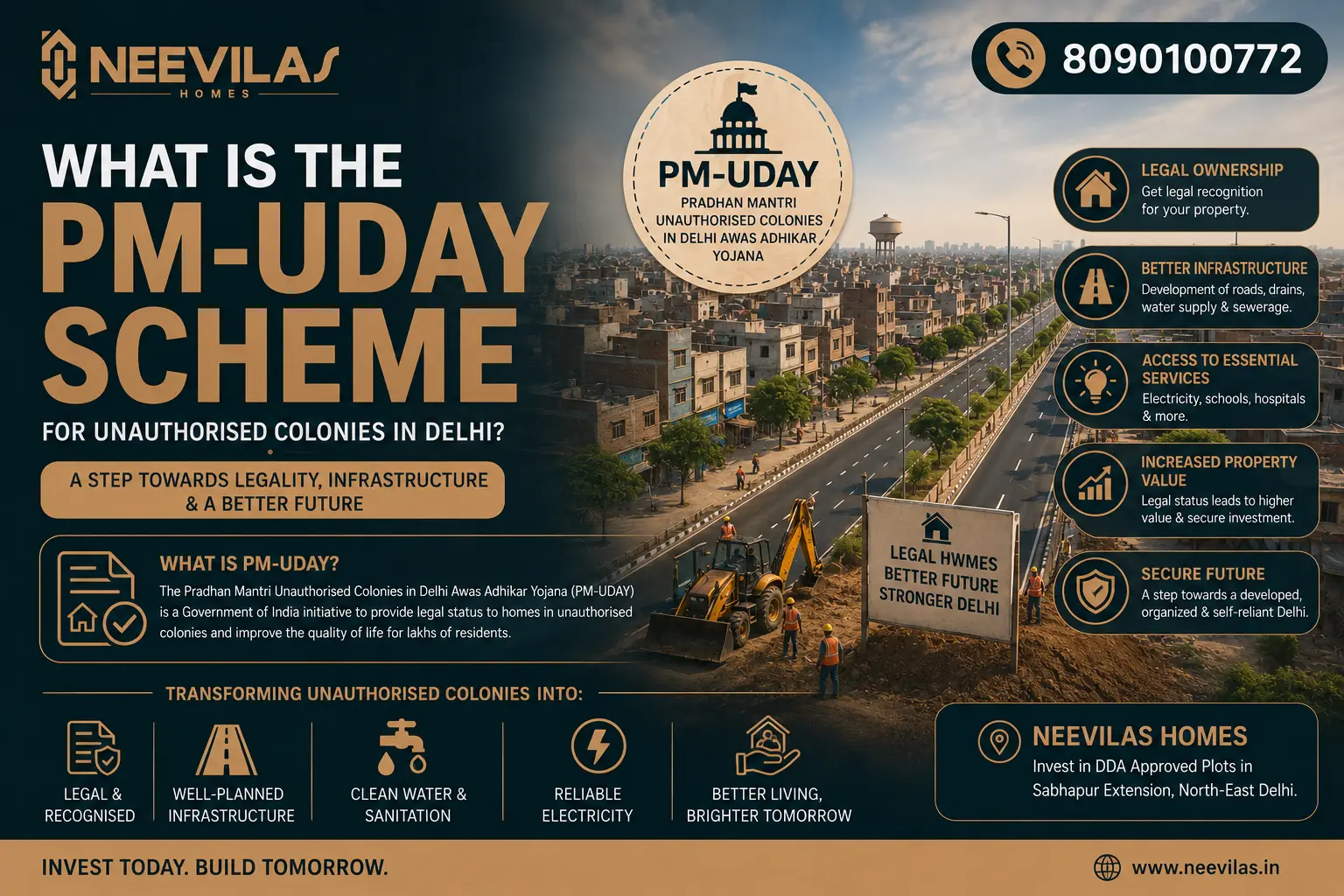
For decades, living in unauthorised colonies in Delhi meant constantly worrying about the legal status of your home. To resolve this, the central government introduced the PM-UDAY scheme Delhi to officially grant ownership rights for Delhi residents who have built their lives in these areas. To speed up this process, Delhi Chief Minister Rekha Gupta has requested an assistance package of Rs 100 crore from the central government’s Urban Development Fund.
This financial boost is aimed at clearing the massive backlog slowing down the regularisation of unauthorised colonies. Instead of forcing neighborhoods to wait indefinitely for approved layout plans, the government is rolling out the high-tech DRISHTI mapping system to digitize boundaries instantly. The ultimate goal is to cut down bureaucratic delays and issue property documents to families within just 45 days, creating urgency as the revised regularisation application deadline of October 31 fast approaches.
Why Has the Delhi Government Requested Rs 100 Crore from the Centre?
The process of legalizing properties for roughly 45 lakh people across 1,511 colonies is an incredibly massive administrative task. Chief Minister Rekha Gupta’s request for Rs 100 crore isn’t just a random number—it is a strategic budget broken down into three specific pillars to make the system actually work for the public:
- Rs 65 Crore for Digital Mapping (DRISHTI): The largest portion will go toward drone mapping and tech-driven boundary surveys. This ensures that properties are recorded accurately and digitally without relying on outdated, slow paperwork.
- Rs 25 Crore for Fast-Track District Cells: This money will fund specialized PM-UDAY cells across all 13 districts of Delhi. Led by Additional District Magistrates (ADMs), these offices are tasked with reviewing applications and clearing them within a strict 45-day window.
- Rs 10 Crore for Public Awareness: Many residents are completely unaware of how the scheme works or how to apply. This fund will set up local help desks, neighborhood camps, and direct workshops with Resident Welfare Associations (RWAs) to guide people through the application process.
What Does the “As-Is, Where-Is” Rule Mean for Property Owners?
To understand why this new update is such a big deal, we have to look at why the scheme previously hit a wall. When PM-UDAY originally launched around 2020 under the Delhi Development Authority (DDA), progress was painfully slow. By early 2026, only about 40,000 property deeds had been handed out.
The main roadblock was that residents couldn’t get their individual building plans approved by the municipal corporation (MCD) because the local RWAs were required to submit a perfectly planned layout map of the entire colony first. Getting thousands of neighbors to agree on and fund a massive structural layout plan caused total gridlock.
To solve this, the government fundamentally changed the rules:
- The Layout Requirement is Dropped: Under the new “as-is, where-is” approach, colonies are being regularised exactly how they stand today. No layout plans required.
- Automatic Residential Status: The land use of all plots and buildings in these 1,511 colonies is now legally categorized as residential.
- A Shift in Control: The responsibility has been handed over to the Delhi government’s local Revenue Department, taking it away from the DDA to put local district magistrates in charge of smooth execution.
What are the Urban Planning Risks Mentioned by Experts?
While the simplified process is incredibly relieving news for families looking for immediate legal safety, urban planning experts have raised some valid concerns about the long-term impact on the city.
In ideal city planning, a colony’s layout map isn’t just an administrative chore—it guarantees that space is left open to widen narrow roads, build efficient sewage lines, manage solid waste, and fix dangerous webs of overhead electricity cables. By completely bypassing layout requirements to speed up individual ownership rights, the city faces a tough future challenge: finding a way to upgrade vital civic infrastructure in neighborhoods that are already intensely crowded and structurally locked in.
What is the Final Deadline to Apply, and What Should You Do?
Because the initial uptake was low, the government has set a firm push with October 31 as the final date for residents to submit their regularisation applications under these newly relaxed guidelines.
If your home falls within one of the 1,511 notified areas, now is the time to act. With the Revenue Department setting up active local help desks and district cells, gathering your property chain documents, old electricity bills, and ownership slips will help you secure your legal property rights before the window closes.