


Delhi’s Master Plan 2047 regularises 1,511 unauthorised colonies on an “as-is-where-is” basis and extends slum rehabilitation cut-offs to 2025. Discover how this decision reshapes real estate, infrastructure challenges, and socio-economic life across the capital.
After years of waiting, false starts and one too many deadline extensions, Delhi finally has its new blueprint for the future. The Delhi Master Plan 2047 (MPD 2047) has been approved by the Delhi Development Authority (DDA), and it is being called one of the most significant urban planning decisions the capital has seen in almost two decades. If you live in Delhi, own property here, or are even remotely thinking about buying a home in the city, this is one piece of news you cannot afford to scroll past.
At its core, the Delhi Development Authority Master Plan is the rulebook that decides how Delhi grows, where new housing can come up, how roads and transport corridors will be widened or added, how much land is reserved for green spaces and parks, and how the city plans to tackle its recurring headaches: traffic, pollution, water shortage, and the ever-expanding footprint of unauthorised colonies in Delhi.
With MPD 2047 timed to align with India’s “Viksit Bharat 2047” vision, the goal of becoming a fully developed nation by the 100th year of independence, this master plan isn’t just a technical document. It’s Delhi’s roadmap for the next two decades, covering everything from the land pooling policy and Yamuna floodplain (O-Zone) regulations to real estate growth in areas like Karawal Nagar, Sonia Vihar and Sabhapur.
So, What Exactly Got Approved?
In short, the DDA’s governing body approved the draft master plan that had been put forth for discussion and scrutiny. Nevertheless, the plan has to be notified by the Ministry of Housing and Urban Affairs, which has yet to take place. Until then, according to the procedure, the current master plan continues to govern the capital. Thus, the draft plan, once approved by the DDA, has a definitive status but still has to undergo the official notification by the ministry.
For the average citizen, it means that the direction in which the city is headed in the years to come has become clear, with some certainty. The document contains a detailed set of directions on how many new houses need to be built, where they can be built (using the land pooling model, in which private landowners can partner with the DDA instead of the government taking possession of their land), how and where roads and metro lines must be constructed to meet the needs of the growing population, and how much of the land should be allocated to parks, nature reserves and the Yamuna riverfront. Most importantly, perhaps, it provides a detailed, comprehensive set of guidelines on dealing with the problem of unauthorised colonies for the first time, something that affects nearly a third of Delhi’s population.
How Delhi’s Master Plans Have Evolved through the years
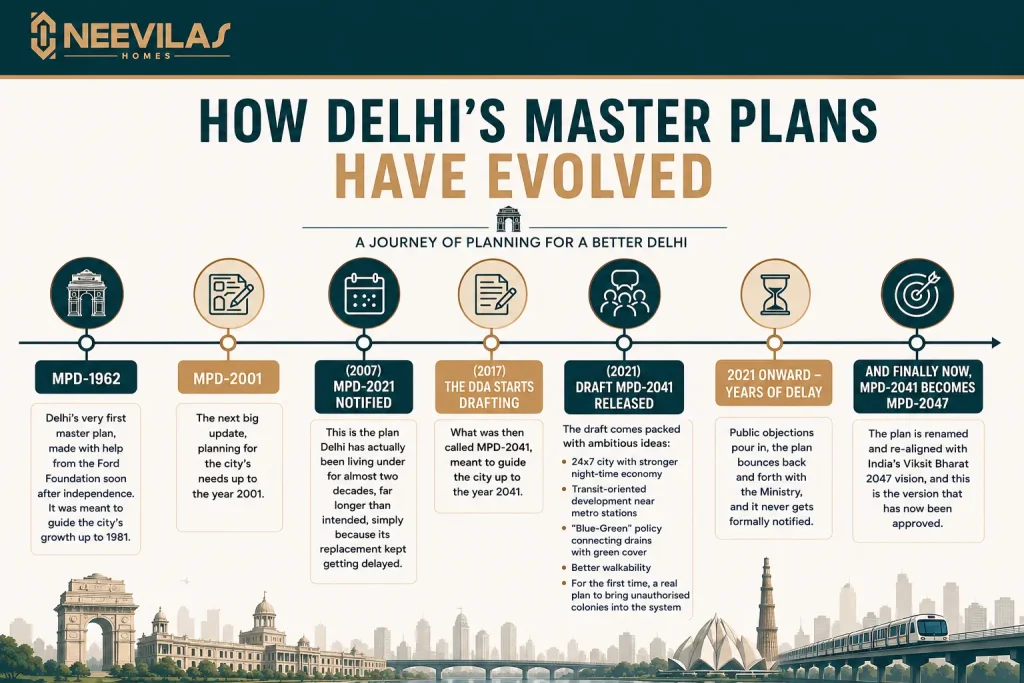
It promised a long list of forward-looking ideas, a 24×7 city with a stronger night-time economy, transit-oriented development around metro stations, a “blue-green” policy tying drainage systems to green cover, better walkability, and dedicated provisions to finally bring unauthorised colonies into the planning fold. On paper, it sounded like exactly what a congested, polluted, traffic-choked Delhi needed.
Why was the Masterplan 2041 delayed till now?
Here’s where things get messy, and where a lot of Delhiites lost patience. Despite the draft being ready by 2021, the plan sat unnotified for years. Thousands of objections and suggestions poured in from residents, RWAs and urban planners, and the DDA had to extend its public consultation window multiple times, partly because the process was conducted online during the pandemic and excluded people without easy internet access.
But the bigger problem was policy-related. The government ministry responsible for housing and urban development kept pushing for changes to the proposed policies, including the contentious land pooling (determining compensation for people whose private land is acquired for development and returned to them later) and rules for managing Zone O, the ecologically sensitive Yamuna floodplain. After all, the 2023 Delhi deluge, when the Yamuna river reached record levels, had made it clear that the floodplain needed to be regulated more strictly.
The delay became so glaring that in October 2023, the Supreme Court of India itself remarked that Delhi was in an “utter mess,” attributing part of the chaos directly to the prolonged non-notification of the master plan. Meanwhile, the first tangible outcome of the land pooling policy only arrived in November 2025, when land-use conversion was approved for a patch near Bhalaswa Lake, years after the policy was first floated. Somewhere along this long and winding road, the plan’s timeline itself was recalibrated from “2041” to “2047,” aligning it with the national Viksit Bharat 2047 vision rather than an arbitrary 20-year horizon.
What It Means for Delhi’s Real Estate, Especially in Areas Like Karawal Nagar, Sonia Vihar and Sabhapur
For Delhi’s real estate market, the approval of MPD 2047 is a big deal. A notified master plan gives developers, homebuyers and financial institutions the legal clarity they’ve been missing for years, clarity on where residential construction is permitted, what floor-area ratios apply, and which zones are earmarked for future infrastructure. This is especially significant for the land pooling zones in outer Delhi, where thousands of hectares are expected to open up for planned housing over the coming years, potentially easing the capital’s chronic housing shortage.
But the plan’s real-world impact is felt most sharply in Delhi’s densely populated, largely unplanned pockets, places like Karawal Nagar, Sonia Vihar, and Sabhapur in North East Delhi. These areas sit close to the Yamuna and are home to a mix of unauthorised colonies and old villages that have grown organically over decades, often without formal planning approval. For residents here, any master plan discussion isn’t an abstract policy debate, it’s about whether their homes, built over years of savings, are secure.
Is Sabhapur extension under O-Zone?
No, Sabhapur Extension is not in O-zone(O zone-1) according to the new master plan 2047. By O-zone, people usually mean the flood-prone area, but in reality the “O-Zone” is actually divided into 2 types of Zoning: Zone-Ⅰ and Zone-Ⅱ.
Zone-Ⅰ is for those areas that come within the range of active floodplains, whereas Zone-Ⅱ is the area which is away from the river, at a distance which is safe from flooding, where construction is authorised by the new masterplan 2047, and already done construction will not be demolished by the “as is, where is” motto of the plan.
Sabhapur Extension is in Zone-Ⅱ, which is atleast 3-km away and further from the active floodplain of the Yamuna River and where construction is actively allowed.
Also in between the River, which is far and Sabhapur Extension, there stands a Pushta Road, which acts as a barrier even if the Yamuna flows beyond danger levels.
The Road Ahead
With MPD 2047 approved, Delhi enters a new planning era, one that, on paper, promises more organised housing, better roads, wider green cover, and a clearer framework for regularising decades-old unauthorised colonies. Whether that promise translates into on-ground change will depend heavily on how quickly the plan gets formally notified, how transparently the DDA communicates with residents in sensitive zones like Karawal Nagar, Sonia Vihar and Sabhapur, and how consistently the land pooling policy is implemented beyond its first pilot approvals.
For now, though, two things are clear: Delhi finally has an updated master plan after years of delay, and residents of the city’s floodplain colonies can breathe a little easier knowing their homes aren’t on any demolition list, at least not for now.